T1: the Korean esports team that transforms in October
BIG IF TRUE
T1 has won the last three League of Legends Worlds, each time as the underdog. We replayed the tournament under the rules of the football World Cup, the NBA and the Premier League to see how often the best team really wins in each format.
BIT VERDICT #002
- The Claim: Ratings updated with this year's official games put the Korean team Gen.G at the top of the world going into League of Legends' 2026 World Championship, above the three-time defending champion, T1: enough to beat T1 about two games in three.
- The Catch: The same ratings have underrated T1's performances over its last nine Worlds: 27 more wins than predicted in 157 games. At MSI, the year's other international tournament, T1 instead plays exactly as rated, as does every other team, with only one other exception in history.
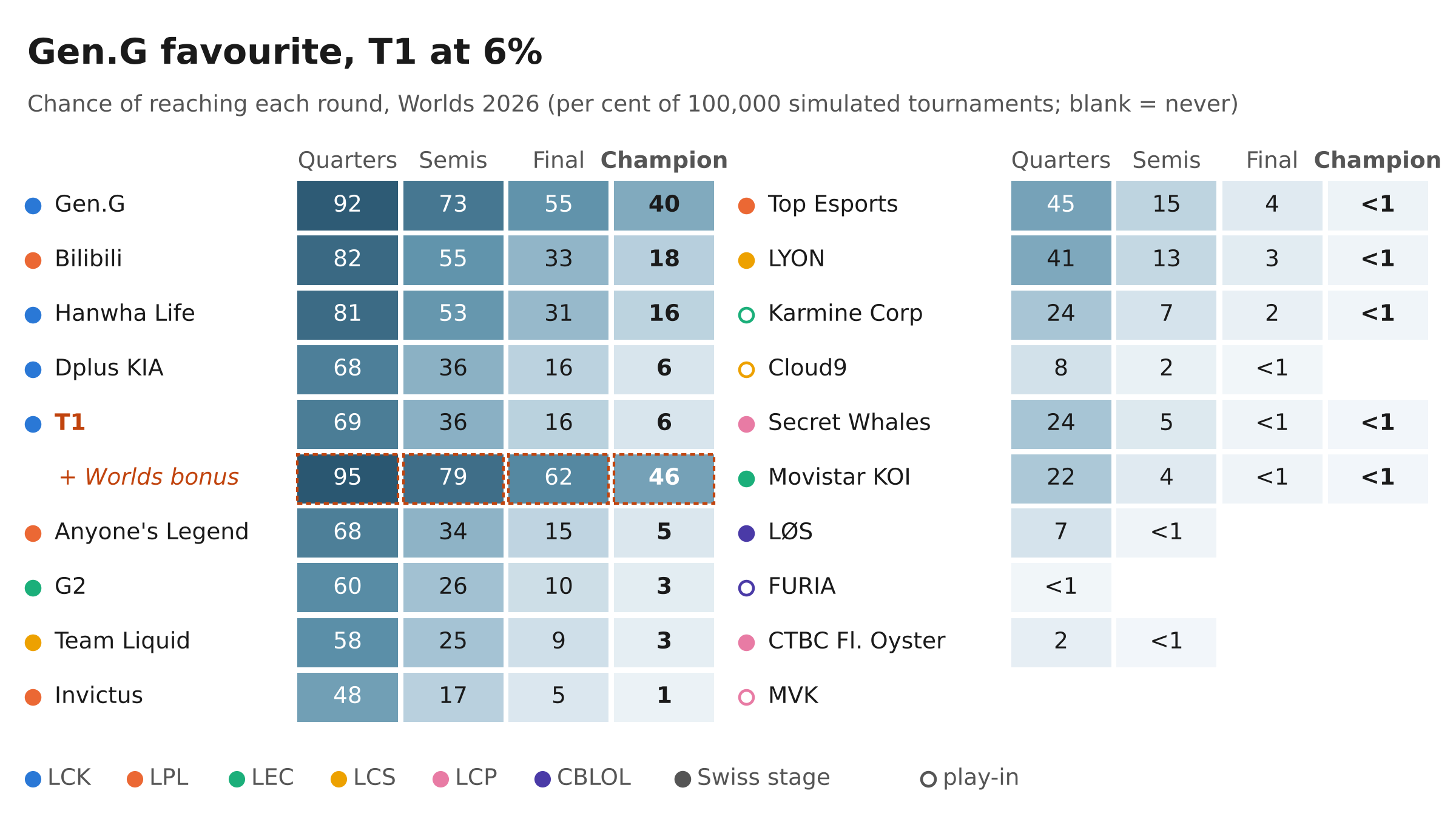
- The Reality: On ratings alone Gen.G wins Worlds 40% of the time and T1 6%. If T1's October bonus holds, T1 becomes the favourite in all seven formats we tried, with best-of-five series: 45% to 56%. Changing the format moves less: Gen.G would go from 27% with single games to 50% with a full league.
League of Legends is a video game played by two teams of five players, and one of the most watched esports in the world; it is also the game behind Arcane, the wonderful animated series on Netflix, which I recommend to non-gamers too; its World Championship, every autumn, is its World Cup. We rated every professional team the way chess rates players, and played every World Championship from 2014 to 2026 tens of thousands of times on a computer, to see how often the ratings pick the winner. Top leagues and international events only, 2011 to 10 October 2026.
BIG — The road to Worlds 2026
I would be an avid gamer, if only I had the time for it. I played video games competitively online before anyone called it esports. In 2000 (three zeros) I played a team game called Team Fortress Classic with a clan, the Italian Killers, and we surprisingly won an Italian tournament. Twenty years later, in 2020, an intern was collecting data on another team game, League of Legends, and to follow his work I started studying the game. I have never played it, but I did end up trying Wild Rift, the simpler version you play on a phone. For anyone curious, I play Orianna, a clockwork automaton the pros use a lot too. I started following the pros in 2023. That was the year of Faker's return to winning. Faker is the veteran Korean player who is to this game roughly what Paolo Maldini was to football: a player of great quality, the undisputed leader, with a very long career tied to a single team. But Faker had not won Worlds since 2016. In July he injured his arm and was out for four weeks; without him T1 was lost, and looked unlikely even to reach Worlds. He came back in August, T1 qualified, and in November Faker lifted the trophy for the fourth time. T1 then won the next two Worlds as well, each time arriving, somehow, as the underdog. In 2026 TIME named Faker among the 100 most influential people in sport: not just in video games, in all sports. Now Worlds is about to start again, and T1 arrives, once more, as the underdog. But can we trust these ratings? To make sense of it, I decided to try to work out the chances of winning.
LEAGUE OF LEGENDS IN ONE MINUTE
- The game. Two teams of five, each player controlling one character, try to destroy the other team's base. A game lasts about half an hour; a match between two teams, a series, is the best of one, three or five games.
- The leagues. Each region has a professional league: the LCK in Korea, the LPL in China, the LEC in Europe, the LCS in North America, the LCP in the Asia-Pacific and the CBLOL in Brazil. Korea and China have won every world title since 2013.
- The two international events. The Mid-Season Invitational (MSI), in early summer, is a smaller tournament between the leagues' top teams; the World Championship (Worlds), in autumn, is the big one, with up to four teams from each of the strongest leagues.
- Worlds 2026. A short play-in sends one more team to a 16-team Swiss stage, where each team plays opponents with the same record until it has three wins (through) or three losses (out). The eight that go through play a knockout bracket of best-of-five series, ending with the final on 14 November in New York.
- The teams in this story. T1 is Korea's most famous team, home of Faker, and has won 6 of the 10 Worlds it has played, including the last three. Gen.G, also Korean, has been the best team on paper for most of the last four years.
To do it, the method I chose is Elo, the system chess uses: a win earns points, more of them against a strong opponent, and the gap between two ratings gives the chance that one beats the other. I used about 51,000 games from every region's top league and every international event since 2011. Because teams mostly play inside their own league, each league also carries a strength rating of its own, which moves only when teams from different leagues meet. Players change teams every winter, so at the start of each year I restart each team's rating at its league's average, while the league's strength carries over; this predicts the results of past Worlds better than carrying individual teams' ratings from one season to the next.
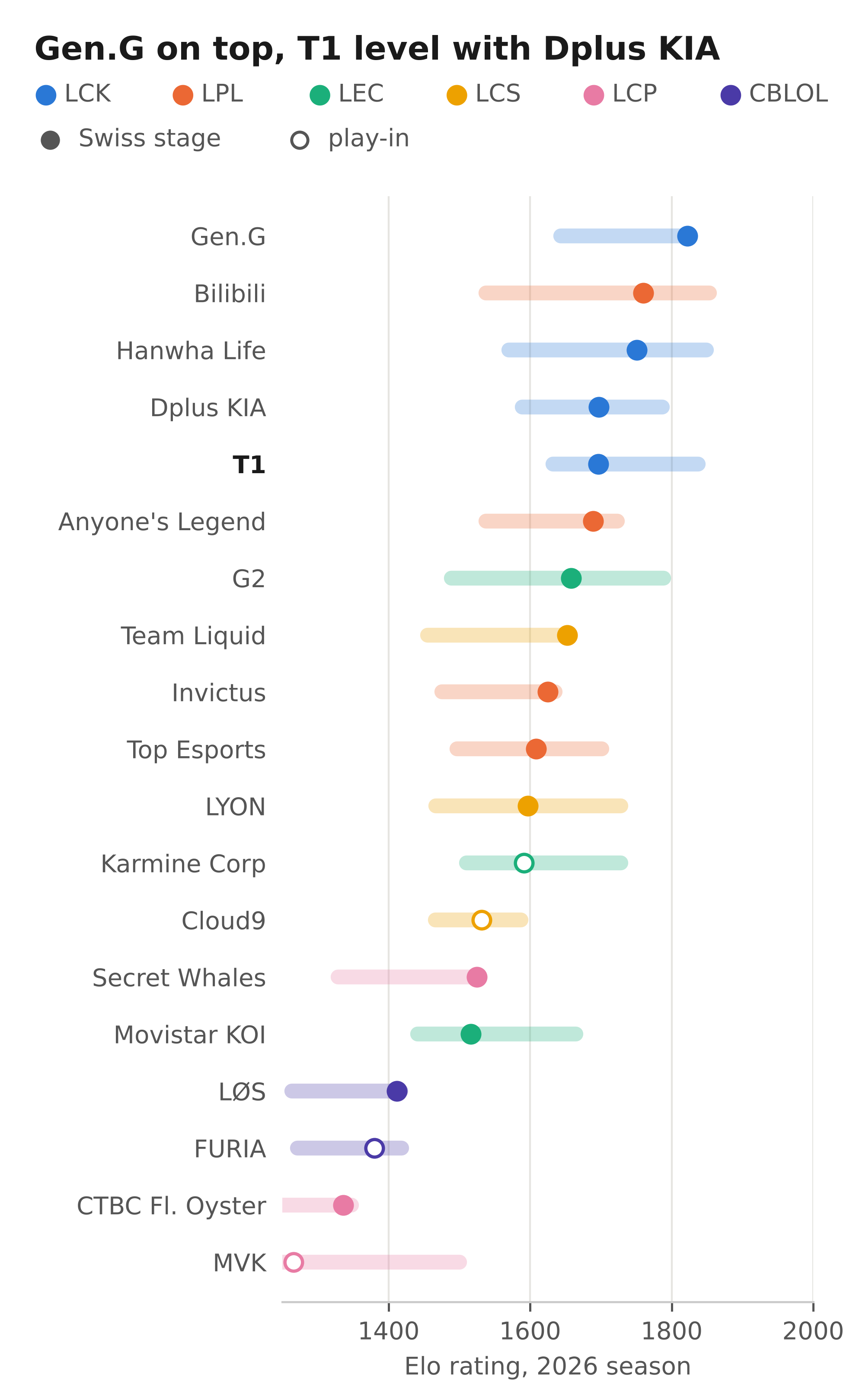
Figure 1. The 19 teams qualified for Worlds 2026, ranked by their Elo rating on 10 October 2026 (dot). The pale bar spans each team's lowest and highest rating during the 2026 season; colour is the league. The dot shows where the team enters Worlds: full for the 16-team Swiss stage, open for the four-team play-in.
Five teams have been rated world No. 1 at some point this year: Gen.G, Bilibili Gaming, G2, T1 and Hanwha Life. Gen.G took the lead back by winning Korea's league, the LCK, in September, and enters Worlds at 1822, about 60 to 70 points ahead of Bilibili and Hanwha Life. T1 is fifth, level with Dplus KIA (1697) at 1696, less than a point behind: on these ratings it would beat Gen.G in about one game in three. The rankings of Riot Games, which makes the game and runs Worlds, and those of lolproelo.com, an independent Elo site, agree: T1 is fourth or fifth on both.
THE NUMBERS 5 — teams that have been rated No. 1 in the world at some point in 2026: Gen.G, Bilibili Gaming, G2, T1 and Hanwha Life 1822 — Gen.G's Elo rating going into Worlds, the highest in the world and about 60 to 70 points clear of Bilibili and Hanwha Life 126 points — the Elo gap between Gen.G and T1, the three-time defending champion: at that distance T1 would win about one game in three
The ratings were just as sure in 2023, about a different favourite. The question is whether to believe them, or the one team that keeps proving them wrong.
IF — Can the ratings call Worlds?
A rating gives the chance of winning one game. Turning that into the chance of winning Worlds depends on the structure of the tournament itself. When I played Team Fortress Classic we had two formats: a ladder, a single standing where teams of similar strength challenged each other whenever they liked, much as chess works online, and knockout tournaments. It is hard to look stronger than you are over the repeated matches of a ladder, but you can pull off a run in a single tournament, as we once did. To simulate these tournaments we played each year's tournament 50,000 times on the computer in its real format: the real opening draw, single games, best-of-threes or best-of-fives where Riot used them, and the rules for who meets whom. The chances that follow are shares of tournaments: 6% means that in 100 Worlds simulated with these teams, a team would win 6. Until 2021 the champion always started among the top three, with a chance between 14% and 43% (Figure 2a). Then in 2022 the Korean outsider DRX won, beating T1 itself in the final, from 2%, and T1 from 2% in 2023, 2% in 2024 and 9% in 2025. For 2026 we give Gen.G 40%, Bilibili 18%, Hanwha Life 16% and T1 6% (The predictions, below). That is less than a place in the top five might suggest. T1 would beat Gen.G in 35% of games and 24% of best-of-fives, but a title means beating three or four of the best teams in a row, and the bracket turns a modest gap into very long odds.
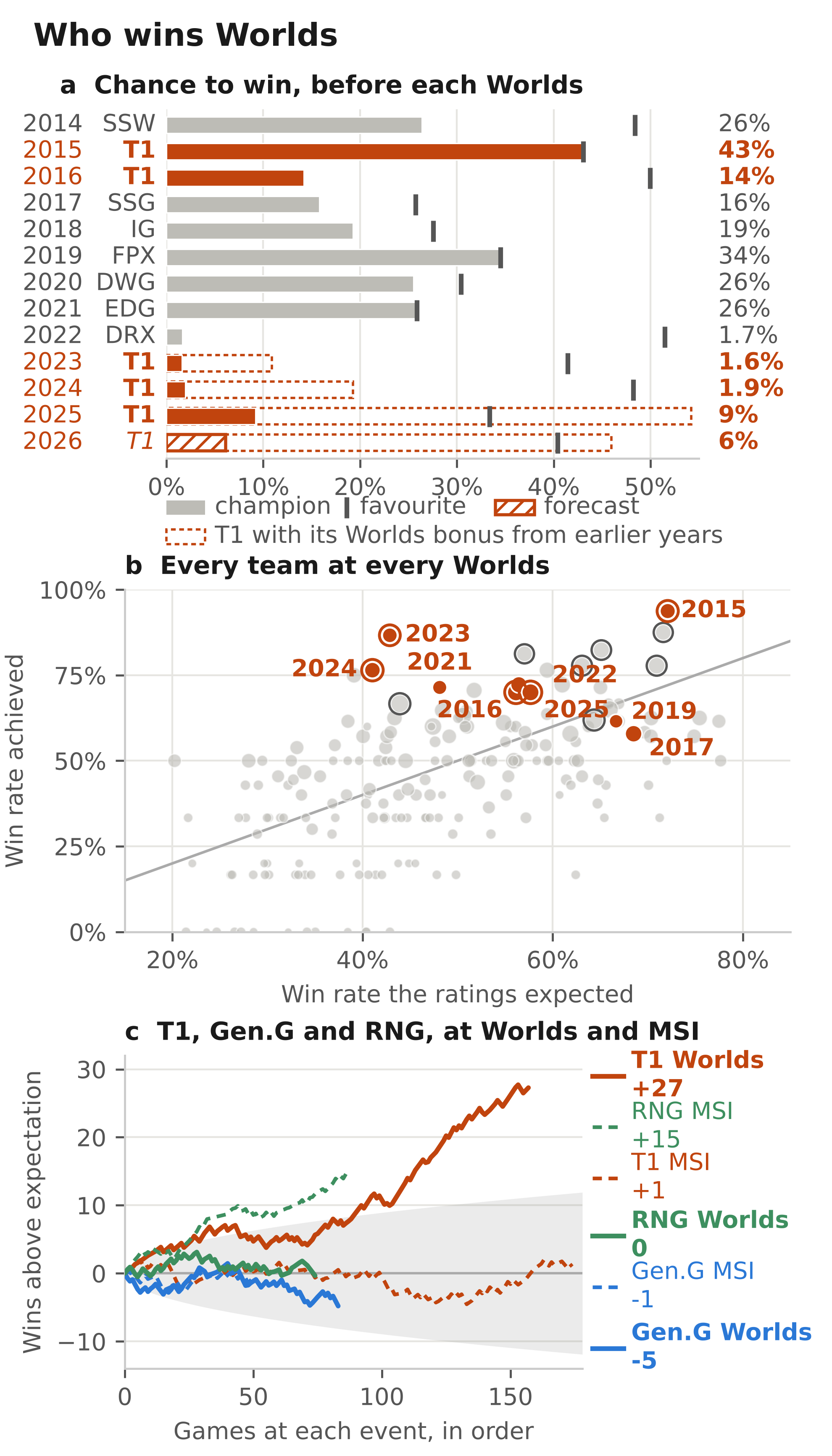
Figure 2. (a) Each Worlds champion's chance of winning, worked out before the main event by simulating that year's tournament 50,000 times from the ratings; the tick marks the favourite's chance. T1's titles are in orange; the hatched 2026 bar ("forecast" in the legend) is T1's chance this year, simulated in this year's format with the play-in. The dashed outlines on T1's last three titles and on 2026 are T1's chance with its Worlds bonus, fitted only on the Worlds before (for 2026, on all of them). (b) Every team at every Worlds main event, 2014–2025: the share of its games the ratings expected it to win, against the share it won. Dot size is the number of games played; ringed dots are the champions; T1's appearances are in orange and labelled by year (the team was called SK Telecom T1 until 2019; the figure calls it T1 throughout). The grey line is where achieved equals expected. (c) Running total of wins above expectation, game by game, for T1 (orange), for Gen.G since it took that name in 2018 (blue) and for Royal Never Give Up (green), at every Worlds (solid) and every Mid-Season Invitational (dashed) each has played. The grey band is the 95% range a team playing exactly to its rating would stay within by luck alone. Ratings are frozen at each event's start.
THE PREDICTIONS
Each team's chance of reaching the quarter-finals, the semi-finals and the final, and of winning Worlds 2026, on ratings alone as of 10 October: 100,000 tournaments simulated in this year's format, with the play-in played out from the real draw (FURIA against MVK, Cloud9 against Karmine Corp), so for the four play-in teams the count includes reaching the Swiss stage. The darker the colour, the higher the chance; blank cells are rounds never reached. The dot gives the league and how the team enters, as in Figure 1. Teams are in rating order. The dashed row is T1 with its Worlds bonus: with it, T1 would rise to 46% and Gen.G would drop to 25%.
A favourite losing is oddly normal: in twelve years the favourite won only three times, against about four and a half expected. One team winning three in a row from those odds, about one chance in 35,000, is not. So we tested the team. For every Worlds, we froze each team's rating on the first day and compared the games it should have won, against the opponents it actually met, with the games it did win (panel b). Most teams sit near the line. In 2023 T1 was expected to win 43% of its games and won 87%, the largest gap for any team at any Worlds. In all, T1 has won 115 of 157 Worlds games against about 88 expected: 27 more wins, more than four and a half standard deviations from what the ratings predict (panel c). Statistically, that is far beyond expectation.
This test could have failed, and it does fail for every other team, and for T1 at MSI. If T1 were simply better than its rating, it would beat its rating everywhere. At MSI, against the same international opposition and with ratings frozen the same way, T1 has won 116 of 174 games against about 115 expected. Nor is it the format. At Worlds, T1 beats its rating in single games (36 won of 45, against 28 expected) as in best-of-fives (71 of 104, against 55), and from the first game of a series; at MSI, where most of its games have been best-of-fives, it does not. The T1 that turns up at Worlds would beat the T1 of the rest of the year seven times in ten (between 62% and 77%), about how a title favourite beats a mid-table Korean team. Leaving out any single year keeps it between 67% and 74%. The tournament simulation is the stronger test, because it asks about titles and not single games. Give T1 the bonus fitted only on the Worlds before each one (the dashed bars in panel a) and its chance becomes 11% in 2023, 19% in 2024 and 54% in 2025; three in a row goes from one in 35,000 to about one in 90.
Gen.G is the mirror image. The favourite at three of the last four Worlds, it went out in the semi-final or earlier every time, while winning MSI in 2024 and 2025. Its lines in panel c stay inside the band of luck at both events. It is not Gen.G that disappoints; it is T1 that is exceptional.
T1 VS CHINA (THE LPL)
- The commentators noticed: in 2023, as T1 closed out JD Gaming in the semi-final, after beating two other Chinese teams on the way, the caster Drakos shouted: "It is not LPL versus LCK! It is T1 versus the LPL! And they like those odds!" Not Korea against China, that is, but one team against a whole league.
- Korea on paper: the LCK's other teams were expected to win about 10 of their 19 best-of-three and best-of-five series against Chinese (LPL) teams at Worlds. They won 7.
- T1: the underdog in 9 of its 12 such series at Worlds main events, it won all twelve, against about 5 expected: a run with about one chance in 100,000. Add the 2025 play-in against Invictus Gaming and it is 13 of 13, one in 220,000.
- The three titles: T1's nine knockout series from 2023 to 2025, at the ratings of the day, had one chance in 42,000 of all going its way. The worst were the 2023 semi-final against JD Gaming (13%) and the 2024 semi-final against Gen.G (12%).
Nobody else comes close. Of some thirty teams tested at both events, the only other record that survives a correction for that many tries is Royal Never Give Up, a Chinese team, at MSI, the green dashed line: 15 wins above its rating there, level with it at Worlds. I don't know this team's story: it won its three MSIs, in 2018, 2021 and 2022, before I followed international tournaments. But the statistics say it was the only other team to do much better than expected, at MSI rather than at Worlds: the only other statistical exception.
It is not our ratings: lolproelo.com's leave T1 23 wins above expectation at Worlds and 7 below at MSI. The betting market saw more. Before Worlds 2023, Pinnacle's odds, with the bookmaker's margin removed, gave T1 about one chance in fifteen, four times our figure; before 2025, Stake's gave it about one in ten, close to ours.
WHAT THE LITERATURE SAYS The closest peer-reviewed work is PandaSkill (De Bois and colleagues, IEEE Transactions on Games, 2025). It rates 4,927 professional players from how they played in 37,388 games, with one strength figure per region that moves only when regions meet, as in our ratings. It picks the winner 65% of the time; our ratings pick 64% of Worlds games, a loose comparison, since theirs covers every professional game and ours only Worlds. That supports ratings as a fair yardstick, but does not test our finding. Closer to it is tennis: González-Díaz, Gossner and Rogers (2012) find that professionals differ in how much they raise their game on the points that matter most, and that this "critical ability" predicts careers. T1 at Worlds looks like a team version of it. On formats, Sziklai, Biró and Csató (2022) find a Swiss system ranks a whole field more accurately than knockouts or groups; for picking the single champion, we find Swiss and groups almost level, and for the full order groups do slightly better (0.67 against 0.62), perhaps because Riot's Swiss stage stops at three wins or three losses.
TRUE — Same teams, different rules
Part of the surprise in Figure 2a is the format's doing: a knockout bracket hands titles to teams that are not the strongest. To separate the two, we kept this year's 16 Swiss-stage teams fixed and changed only the rules, 40,000 tournaments each, with every knockout series a best-of-five. Each format, in the order of Figure 3, has a cousin in other sports:
- Swiss stage, then knockouts, this year's format: its cousin is the Champions League, which since 2024 opens with a single table in which each club meets eight different opponents.
- Groups, then knockouts, the Worlds format until 2022: the football World Cup's formula.
- Knockout, random draw: like England's FA Cup, where the strongest clubs are not kept apart.
- Knockout, seeded, so the strongest teams meet only at the end: the bracket of tennis's Grand Slams.
- Double elimination, where a team that loses a series gets a second chance: MSI's bracket, after its play-in, and college baseball's College World Series.
- League, then playoffs, a league of single games followed by playoffs for the top eight: the NBA's formula.
- Full league, home and away: every team plays every other twice, 30 games each, as in the Premier League or Serie A.
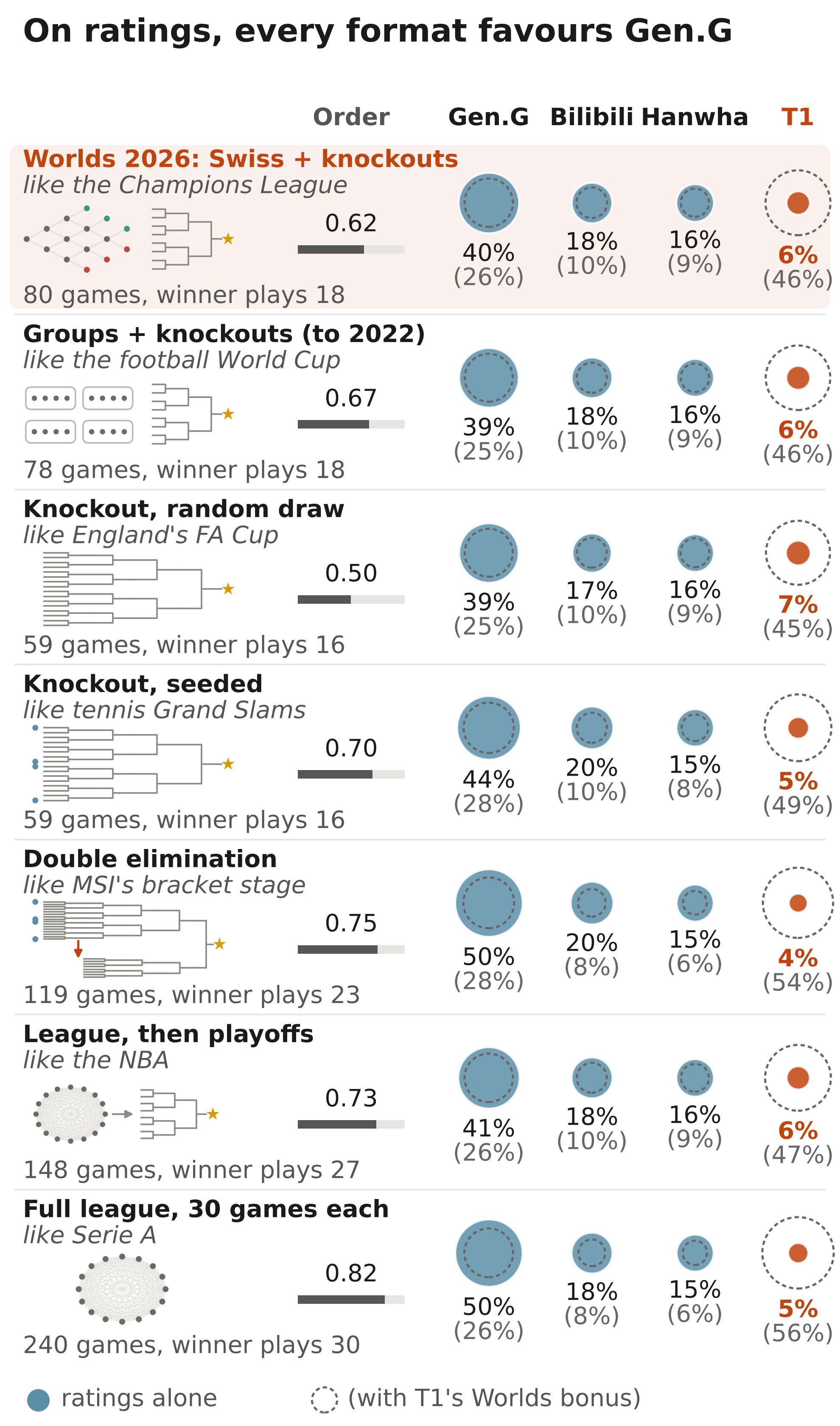
Figure 3. Chance of winning Worlds 2026 for the four leading contenders under seven formats, 40,000 tournaments each, with this year's 16 Swiss-stage teams; every knockout series is a best-of-five. Filled circles and the upper number: ratings alone. Dashed rings and the number in brackets: the same ratings with T1's Worlds bonus from the IF beat (T1 would beat itself seven times in ten). Circle area is proportional to the chance. The small drawing beside each format shows its structure: Swiss stage (three wins to go through, three losses to go out), groups of four, league followed by a bracket, bracket (blue dots mark the seeds; in double elimination a team that loses a series drops, red arrow, into the lower bracket below, and the two bracket winners meet in the final), or league. In italics, a tournament from another sport with the same structure. Under each: the average number of games in the whole tournament and the number the winner plays. The "Order" column shows how closely the whole final ranking follows the starting ratings: the rank correlation, from 0 (random order) to 1 (identical), averaged over 4,000 tournaments. In brackets, as at the real Worlds, two teams from the same region do not meet in the first round. Here the play-in is not played: its place always goes to Karmine Corp, the likeliest winner, and the first-round pools are set by rating. That is why the row for this year's format can differ by a point from the predictions, where the play-in is played every time.
On ratings alone (the filled circles) Gen.G is the favourite under every format, at 39% to 50%, and T1 is never above 7%: it arrives as the underdog once again. If its Worlds bonus held one more time (the dashed rings), its chance would be about one in two: from 45% to 56%, depending on the format.
To let the strongest team win and get a final table that follows the ratings, the best format is the home-and-away league: with Gen.G at 50% and a rank correlation between finishing order and ratings of 0.82 (1 if they match, 0 if the order is random), against this year's format, which holds it to 40%, at 0.62. But it takes 240 games, 30 per team, which do not fit into a month-long tournament, and one time in eight the title is settled three rounds before the end; with a single round, 15 games each, the correlation drops to 0.72 and Gen.G wins 39% of the time. If you want close and exciting matches, where even the favourite wins at most two times in three, double elimination gives the most: nearly eleven per tournament, against more than eight in the Swiss stage; but it costs 119 games, against the 80 of this year's format, and the final is often a rematch of a semi-final, the upper-bracket final, whose loser gets a second chance: it happened in three of the four MSI finals since 2023, and in the MSI format our simulations expect it about one time in two.
Series length matters too. With best-of-seven knockouts, as in the NBA playoffs, Gen.G rises to 45%, but it takes 91 games, 23 for the winner; with single games, as in football, this year's Swiss format would give Gen.G only 27%, and T1 8% (31% with the bonus). The same happens at this summer's football World Cup: replaying the real round-of-32 bracket with Elo ratings for national teams (the eloratings.net method), Spain, the favourite and eventual champion, won 26% of the time with one match per tie and 50% with best of seven.
A seeded bracket, as in tennis, would be hard to run in LoL. Tennis has a single world ranking; here teams play almost only in their own league, and leagues meet only in the handful of international games each year. That is why Worlds draws its pools by placement in each league: this year Team Liquid, North America's champion, is in the first pool, while Hanwha Life and Bilibili, about 100 points stronger, are in the second.
In short: finding the strongest team and a faithful table takes many games. The home-and-away league is the fairest format, but also the longest, and it is sometimes decided before the end; double elimination comes close with half the games, at the price of finals that, one time in two, replay the upper-bracket final; this year's format is a compromise that leaves more room for underdogs, and football's single games leave even more. But no format moves the odds as much as T1's bonus does.
THE NUMBERS 50% against 40% — Gen.G's chance in a home-and-away league and in this year's format 240 games against 80 — the price of that league, 30 per team, against this year's Worlds from Swiss stage to final 27% — Gen.G with single-game knockouts, as in football; T1 would go to 8% (31% with the bonus)
If T1's October form is real, T1 is the team to beat under every set of rules. If it is not, it is Gen.G, with a favourite's usual chance: one in two at best. The final in New York on 14 November settles it.
When we won that tournament with the Italian Killers, twenty-six years ago, we knew we were not the favourites. We went ahead early in the first round and then defended the lead with the most strenuous Italian catenaccio. This year too T1 is not the favourite, but I will follow its run hoping that this piece about its bonus does not turn out to be a spectacular jinx. A rating is the best summary I have of a team. But for one team, in one month, it stops making sense. And that is the beauty of it too: knowing you can be surprised. If the team with the highest rating always won, the predictions table would be enough and nobody would watch the final. Following T1 these past three years taught me that unpredictability is the fun part, and that the underdog stories are the ones we remember.
As I said, in Wild Rift I mostly play Orianna. Orianna hardly ever fights in person: she sends a clockwork ball where it is needed and gives it orders, and the ball does the work. That is more or less how this newsletter is made. I choose the question and the framing; Claude finds the data, writes the code, runs the simulations and writes a first draft; then I send it back when a number does not convince me, ask for the test that could sink the piece, and decide what stays. The ball remembers what it did and where it went wrong, which is why every issue ends with its cards on the table: what the model did, what went wrong and was fixed, and the code to check it. That is the idea of this blog: questions that come to me on a train or in front of a screen, which once took a month of coding and now take an afternoon of talking with Claude. Light questions, like which format is best for a LoL tournament, taken with the same care as serious ones, like summer heat. Each piece is probably right, and it would be interesting if it were: hence the name BIG IF TRUE. I wrote down the longer version, how it works and why you should not simply trust it, in a short manifesto.
What this is and isn't
- What the metric is not. An Elo rating is a summary of results, not a measure of skill, form or roster. It does not know about player transfers, injuries, the game's regular updates, or the draft, the turn-by-turn choice of characters before each game, and it gives each game the same weight whether it is a regular-season game in February or a world semi-final.
- Sampling. Twelve Worlds main events (2014–2025), nine of them with T1. T1's first title, in 2013, is left out: the ratings start in 2011 and the early years are needed to estimate the strength of the leagues; counting it, T1 would beat expectations that year too, with 15 wins against 10.6 expected, and the total would go from 27 to almost 32. For T1, 157 Worlds games and 174 MSI games; twelve best-of-three or best-of-five series against LPL teams at main events. The T1 bonus is estimated from those 157 games, and its range (102 to 255 points) is wide because that is not many. The analysis started from T1 because T1 kept winning: the MSI comparison and the forward test exist to guard against that, but they cannot remove it entirely. The LPL record is part of the same Worlds games, not a second, independent finding. Betting odds were found for two years only (2023 and 2025), from two bookmakers.
- Definitional precision. "Expected" wins use each team's rating frozen on the day the event starts, against the opponents it actually met. The format of an event (since 2023 MSI's main bracket, after its play-in, has been double elimination; the Worlds knockout bracket is single elimination) changes whom a team meets and how often, not the yardstick: T1's MSI games since MSI went double-elimination in 2023 are within two wins of expected, as before. A team that improves during a tournament therefore looks lucky; that affects every team, but T1 may simply be the best at it. Games inside a series are treated as independent: we ignore that winning one game may make a team more likely to win the next, or the draft. Game counts in Figure 3 are averages over simulated tournaments.
- Direction of bias. On Worlds games our ratings predict about as well as lolproelo.com's, slightly better by one measure and slightly worse by another, and in 2025 they rated FlyQuest and G2 too close to the top Korean teams, so our regional adjustment probably reacts slowly. The simulations treat each rating as exact, ignoring how uncertain it is, which overstates favourites: Gen.G's chances, and T1's with the bonus, are therefore more likely too high than too low.
- Scope. Main events only: past play-ins are not simulated, and each year starts from the teams that came through. For 2026 the play-in is simulated too, from the real draw of 10 October; the first-round Swiss pairings, drawn after the play-in, are drawn by the simulator. Historical first rounds use the real draws; later rounds follow Riot's rules (no rematches in the Swiss stage, 3–0 teams kept apart in the knockouts, group winners against runners-up from other groups).
BIT — CARDS ON THE TABLE
- Model & code. Every step of this analysis, from downloading the data through the Elo ratings, the tournament simulators for each year's format and the comparisons with published ratings and betting odds, to the charts, was written and executed by Claude Opus 5.5 (Anthropic), in one extended session working from my instructions. I set the questions and the framing; the model did the work.
- Usage. At least 63 million effective tokens (Claude Opus 5.5, in a Cowork chat and in Claude Code), counting only the parts of the work the logs kept; the true figure is higher. What was counted is in the repository.
- Bugs found and fixed in development.
- My own 2025 notebook, the starting point: it played every knockout series as one game instead of best-of-five, which flattens the odds towards upsets; it drew the play-in result once and reused it for all 100,000 tournaments; it re-shuffled the wrong group before the last Swiss round.
- A text match counted the IEM World Championship, a different tournament, as Worlds, which inflated T1's over-performance by two wins.
- Group-stage tiebreakers skipped Riot's head-to-head rule (effect at most 0.3 percentage points).
- The first table of Korea–China series used stale 2025 ratings and merged pairs of single games into series; rebuilt from Leaguepedia match ids, T1's unbeaten run against the LPL went from one in 48,000 to one in 100,000.
- Teams renamed over the years (SK Telecom T1 to T1, Samsung Galaxy to Gen.G, DAMWON to Dplus KIA) had to be joined by hand, or their ratings would have restarted.
- The first version of the ratings pulled the leagues' strength part of the way back together each winter. Testing showed this made Worlds predictions worse; the final version carries it over in full.
- North America's last qualifying result was first taken from Wikipedia, which had it the wrong way round (Cloud9 beating LYON). Checking two news reports the next day showed LYON had won; the forecast was rerun.
- An early figure listed Team Liquid's path to Worlds as undecided when it was already sure of the Swiss stage.
- The Italian figures came out with a stretched vertical scale: the step that translates the labels changed their limits. All were redrawn.
- The comparison with a Bradley–Terry model first predicted 50% of games right, no better than chance: its time weights were not normalised. Fixed.
- The code that rebuilds the order of games inside a series used a function that changes at every run: rebuilding the file reorders 978 of 51,034 games (1.9%). The published numbers use the original file; the effect on ratings is a few points at most.
- The text said "six results added by hand" when there were five; with the Brazilian final they became six.
- An aside of mine placed Royal Never Give Up's success before I followed the game; two of its three MSI titles came after. I rewrote it.
- The Figure 1 script still drew an old title ("T1 joint fourth"); the published figure was right, but anyone rerunning the code would have seen the old title.
- The full log is in the repository. Every error listed here was caught and fixed before publication. I cannot promise none remain.
- Data sources. Game and series results: Leaguepedia, via the
gptilt/lol-esports-matchesdataset on Hugging Face (snapshot of 27 September 2026, CC BY-SA 3.0), plus six series results from 27 September to 10 October added by hand from Sheep Esports, Dot Esports, Terra, Strafe and Pichau Arena. Riot Games' LoL Esports Global Power Rankings, 2024–2026. lolproelo.com ratings as of the day before each Worlds and MSI. Betting odds: Pinnacle's outright preview of 26 September 2023, and Stake's outright odds as reported by win.gg on 13 October 2025, margin removed by normalising. Worlds formats and rules: Wikipedia's tournament pages for 2019 and 2024, and the 2026 format and qualification as reported by Sheep Esports, esports.gg, Fragster and Insider Gaming. Faker's 2023 injury: Wikipedia, "Faker (gamer)"; Dexerto, 19 November 2023. Drakos's call, T1 against JD Gaming, Worlds 2023 semi-final broadcast, as transcribed by the author. Football: national-team results from themartj42/international_resultsdataset on GitHub (to 6 October 2026), with Elo ratings we computed using eloratings.net's published method.- Related peer-reviewed work.
- De Bois, M., Parmentier, F., Puget, R., Tanti, M., & Peltier, J. (2025). "PandaSkill — Player Performance and Skill Rating in Esports: Application to League of Legends." IEEE Transactions on Games 17(4), 989–1002. doi:10.1109/TG.2025.3581070. Rates players and regions with the same two-level idea as ours and predicts about as well; it does not look at T1 or at Worlds against MSI. Figures quoted from the arXiv version (2501.10049).
- González-Díaz, J., Gossner, O., & Rogers, B. W. (2012). "Performing best when it matters most: Evidence from professional tennis." Journal of Economic Behavior & Organization 84(3), 767–781. doi:10.1016/j.jebo.2012.09.021. Players differ in "critical ability", raising their game on important points: the individual analogue of a Worlds-specific bonus.
- Sziklai, B. R., Biró, P., & Csató, L. (2022). "The efficacy of tournament designs." Computers & Operations Research, 144, 105821. doi:10.1016/j.cor.2022.105821 (arXiv 2103.06023). Finds the Swiss system the most accurate design for ranking a field; it asks about the whole ranking, not the champion.
- Code and data. github.com/bigiftruebits/bit-002-worlds-t1; archived, code and data together, at 10.5281/zenodo.23326955.
- How to cite. This is not a peer-reviewed publication. If you need to reference it anyway, cite the archived code and data: Gallotti, R. (2026). BIG IF TRUE #002: T1: the Korean esports team that transforms in October [Code and data]. Zenodo. 10.5281/zenodo.23326955
I would rather someone found a mistake than that nobody looked. Code and data are open, and published with every issue.